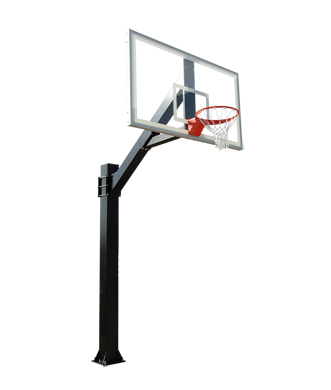


A great looking system that will hold up in the most demanding applications while
surpassing athletes' expectations with gymnasium quality play. A massive 8 inch square pole
delivers an incredible base of stability. The regulation 72 inch glass or steel backboard projects
into the playing area five feet making it perfect for courts with regulation striping or for elemntary
schools where children tend to clump up underneath the basket.
Institutional durability never looked so good
Massive 8" square pole will hold up to all play for decades
Extra long 5' overhang allowing for a regulation baseline on courts
Regulation size 72"e; board available in glass and steel
| Backboard | 72"Full Regulation, available in glass or steel |
|---|---|
| Overhang | 5'Longest available, gets pole out of play |
| Pole | 8" x 8"Long-lasting rigid play |
| Rim | Dual Spring Break-Away25lbs alone, made for dunking |
| Pole | |
| Pole Size | 8" x 8" with 3/16" (7 gauge) thickness |
| Steel Type | Structural (mild) carbon steel with .29% carbon and a density of 7.85 g/cm3 |
| Pole / Gusset Padding | Included. Custom fitted weather resistant vinyl covering with 1" thick high-impact padding |
| Flanged Base | 14.2" x 14.2" x ½" self-leveling |
| Flanged Base Holes | Oblong allowing you to square by twisting |
| Gussets | 8 of them each 3/8" thick |
| Backboard | |
| Backboard Size | 72" x 42" x 1/2" |
| Backboard Material | Tempered Glass or Steel |
| Backboard Padding | Available custom fitted weather resistant polyurethane-skinned 1" thick high-impact padding with molded steel inserts for mounting. |
| Tempered Glass Backboard | |
| Backboard Frame Size | 2" with ¼" thickness |
| Backboard Frame Material | Aluminum with steel reinforcement |
| Glass To Frame Mounting | Mechanically encased in channel with rubber gasket |
| Rim Mounting Type | Through glass using grommets. No pressure on glass. |
| Steel Backboard | |
| Color | White with orange striping |
| Frame | Tubular steel full-surround |
| Extension Arms | |
| Overhang | 5' (front of pole to front of backboard) |
| Main Extension Arm | 5" x 5" with 1/8" (11 gauge) thickness. Has "A" frame type secondary arm |
| Shipping | |
| Service | Included* LTL freight curb-side delivery |
| Lift-Gate | Included |
| Scheduled Delivery | Included |
| Residential Delivery | Included |
| Weight | 644 lbs. |
| Shipping Weight | 764 lbs. |
| Packaging Configuration | 6 cartons accross 2 pallets |
| Fasteners (nuts bolts & washers) | |
| Material (Standard Version) | Structural (mild) carbon steel with .29% carbon and a density of 7.85 g/cm3 |
| Material (Rust Armor Version) | Stainless steel with UNS Designation of S20100 |
| Rust Armor Version | |
| Available | Yes |
| Structural Treatment | Hot Dip Galvanization |
| Fastener Material | Stainless steel with UNS Designation of S20100 |
| Warranty | Extended. Covers corrosion damage as long you own the system |
| Anchor and Pier | |
| J-Bolt Count | 6 |
| J-Bolt Size | 3/4" diameter 18" long |
| J-Bolt Material | Ultra-high carbon steel with zinc galvanization |
| Warranty | |
| Limited Lifetime Warranty | Yes |
| Covers Dunking & Hanging | Yes |
Receive your hoop a day faster
Order within and we’ll ship today
Thinking about self-install? You’re not alone.
Installation Directions
Installation Video Pier Assembly
Resources Center
Installation Directions
Installation Video Pier Assembly
Resources Center